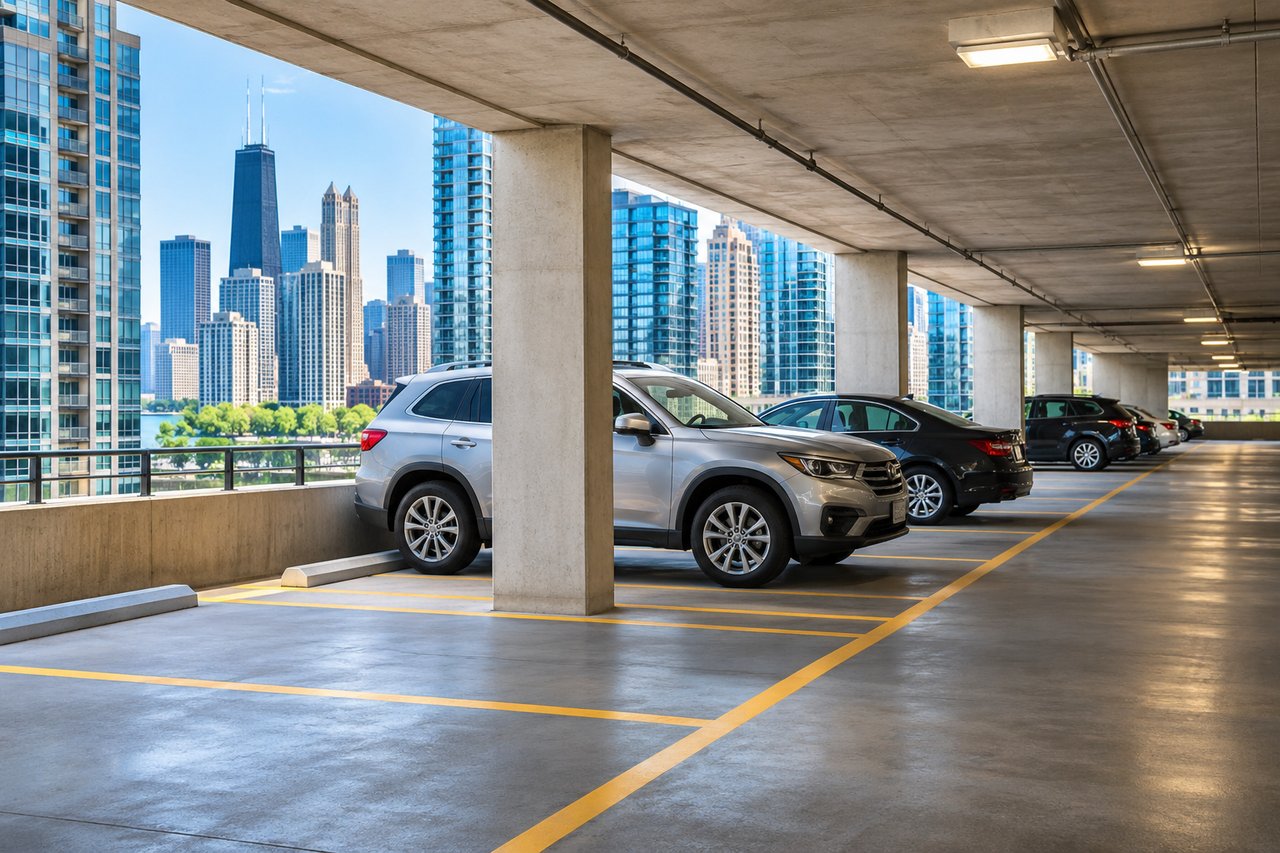
How parking ownership affects your asking price, buyer interest, and selling strategy in downtown Chicago.
When selling a downtown Chicago condo, should you include parking in the asking price or offer it separately?
It's a decision that can affect how buyers discover your listing, how your property compares with competing condos, and how buyers evaluate the total purchase price.
The answer depends on your building, the type of parking you own, and what buyers expect in your market.
1. Should You Include Parking in Your Condo's Asking Price?
In downtown Chicago, separately deeded parking is frequently advertised as an additional purchase. However, including it in the asking price may be a better strategy for certain properties.
Pricing parking separately may position your condo within a lower buyer search range and attract buyers who don't need parking.
Including parking in the asking price provides one combined price and may appeal to buyers who expect a dedicated space.
Neither approach automatically produces a higher selling price.
The goal is to attract qualified buyers while protecting the seller's overall financial outcome.
2. A Practical Pricing Example
Consider a hypothetical downtown Chicago condo valued at $400,000 with a separately deeded parking space valued at $30,000.
There are two possible marketing approaches:
Pricing Strategy | Advertised Price |
|---|---|
Condo with parking included | $430,000 |
Condo priced separately | $400,000 + $30,000 parking |
Both represent a combined asking price of $430,000, but they may reach different buyers.
A buyer searching for condos priced up to $400,000 may discover the separately priced listing but not the combined listing.
However, pricing parking separately does not necessarily mean it can be purchased separately. If the buyer must purchase both, that requirement should be clearly disclosed.
The listing must also follow applicable MLS pricing and disclosure rules.
This example is hypothetical and does not represent a specific property or current market valuation.
3. How Parking Affects Comparable Sales and Buyer Expectations
When evaluating a downtown Chicago condo, comparing properties with and without parking can lead to misleading conclusions.
For example, two similar condos may sell for different amounts because one transaction includes deeded parking while the other does not.
As a listing broker, I evaluate more than the recorded selling price. I consider:
- Whether parking was included in comparable sales.
- Recent parking-only transactions and current availability.
- How competing listings advertise parking.
- Whether buyers in that building typically expect parking.
Buyer expectations vary.
For smaller condos near public transportation, parking may be less important. For larger or higher-priced residences, a dedicated space can be a significant selling feature.
An effective pricing strategy considers the total value of the condo and parking—not simply the advertised price of each component.
4. Understanding Parking Ownership and Selling Restrictions
Before deciding how to market parking, sellers should confirm what they actually own.
Deeded Parking
Deeded parking is a separately owned condominium parking unit, typically with its own legal description, Property Index Number (PIN), and property tax assessment.
It may be sold with the condo or independently, subject to condominium declaration restrictions and any applicable mortgage lien.
Limited Common Element Parking
Limited common element parking is part of the condominium's common property designated for the exclusive use of one or more units.
It generally does not have a separate PIN or property tax bill.
These parking rights typically transfer with the associated condo. A separate transfer may be possible only under specific conditions established by Illinois law and the condominium documents.
Leased Parking
Leased parking provides access without ownership.
Since the seller does not own the space, there is no parking asset to include in the sale price. However, rental rates, availability, and transferability of the parking agreement may influence buyer interest.
5. Can You Sell Deeded Parking Separately If You Have a Mortgage?
This is an important distinction for Chicago condo sellers.
Pricing parking separately in a listing is not the same as selling it separately to another buyer.
For example, a seller may advertise a condo for $400,000 and deeded parking for an additional $30,000, then sell both to the same buyer in one transaction.
If the condo and parking are covered by the same mortgage, the loan is generally paid off at closing, with the lender's lien released as part of the transaction.
However, selling the parking space independently while retaining the condo can be more complicated.
If the mortgage covers both properties, the lender may need to approve a partial release of the mortgage lien before the parking can be transferred with clear title.
The lender may require a principal payment or impose other conditions.
A separate PIN does not necessarily mean the parking is free of a mortgage lien.
Before marketing deeded parking for an independent sale, sellers should have their attorney verify the condominium declaration, title, and mortgage documents.
6. What Sellers Should Verify Before Listing
Before placing your Chicago condo on the market, confirm:
- Parking ownership: Is the space deeded, a limited common element, or leased?
- Property taxes: Does it have a separate PIN and tax assessment?
- Monthly expenses: Are there additional HOA assessments or parking fees?
- Selling restrictions: Can the parking be sold independently?
- Mortgage: Does the existing loan cover both the condo and parking?
- Market value: What have comparable condos and parking spaces recently sold for?
These details help establish an appropriate pricing strategy and reduce the risk of complications during negotiations and closing.
Frequently Asked Questions About Chicago Condo Parking
Should I include deeded parking in my condo's listing price?
It depends on comparable sales, buyer expectations, and competing listings. The best approach is the one that positions the complete offering competitively.
Does deeded parking have its own PIN in Chicago?
A separately deeded condominium parking unit generally has its own legal description, PIN, and property tax assessment.
Can I sell deeded parking separately if I still have a mortgage?
Possibly. If the parking is included in the mortgage collateral, the lender may require a partial release of the lien. Condominium restrictions must also be reviewed.
Do I pay separate property taxes on limited common element parking?
Generally, no. Limited common element parking does not have its own separate PIN or tax bill. Its value may be reflected in the assessment of the associated condominium.
Does parking increase my Chicago condo's resale value?
Parking can improve marketability and contribute to resale value, particularly where spaces are limited. Its actual value depends on buyer demand, the building, and comparable sales.
The Bottom Line: Pricing Your Chicago Condo and Parking
Whether to include parking in your asking price is a marketing decision that should be supported by comparable sales, buyer expectations, and a clear understanding of ownership rights.
The objective isn't simply to advertise the lowest price. It's to position your property effectively and achieve the strongest possible overall selling outcome.
Considering selling your Chicago condo? Find out how your property—and its parking—compares with current competition.
Find Out What Your Chicago Condo—and Parking—Could Sell For
About Larissa Brodsky
Larissa Brodsky is a Chicago real estate broker and downtown condominium listing specialist with experience dating back to 2008. She helps owners throughout Lakeshore East, Streeterville, River North, the Loop, and Gold Coast prepare, price, and market their properties.
Her approach combines building-specific market knowledge, data-driven pricing, and strategic marketing to help sellers make informed decisions.
Disclaimer: This article is provided for general informational purposes only and does not constitute legal or tax advice. Larissa Brodsky is a licensed real estate broker, not an attorney. Parking ownership, transfer rights, condominium association rules, and tax obligations may vary by property. For all legal questions, buyers and sellers should consult a qualified Illinois real estate attorney. Tax-related questions should be directed to a qualified tax professional.