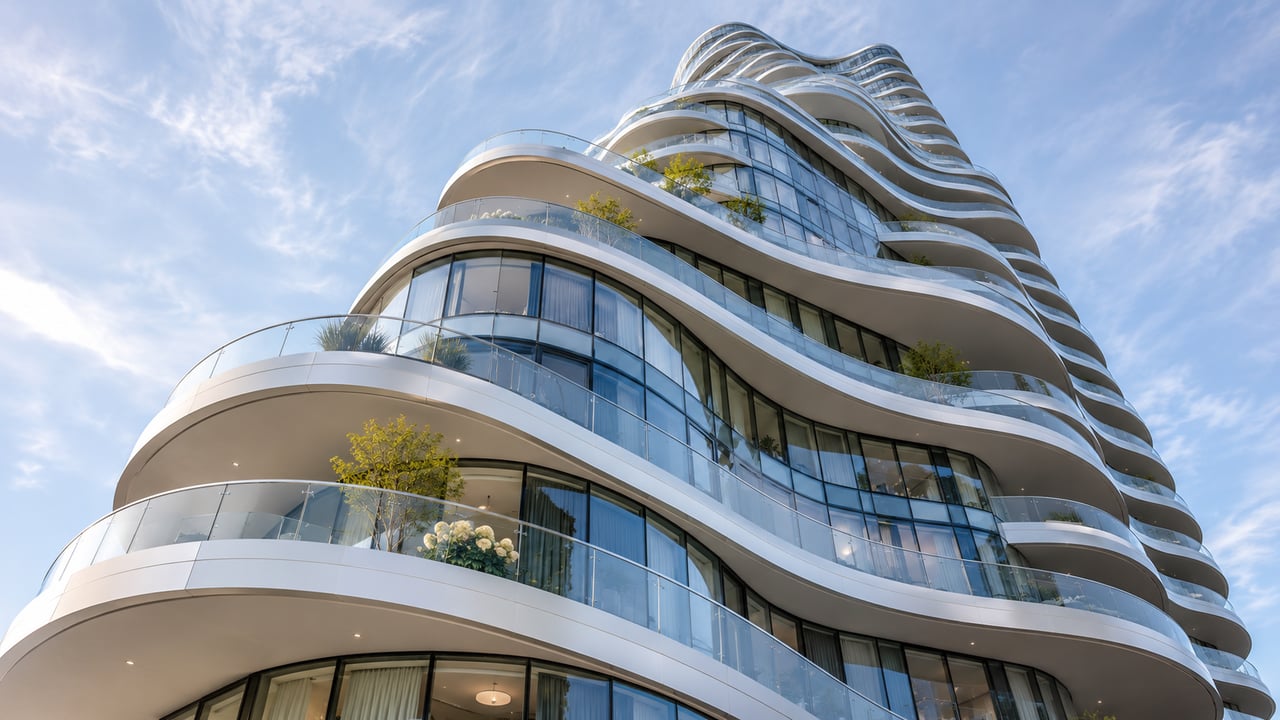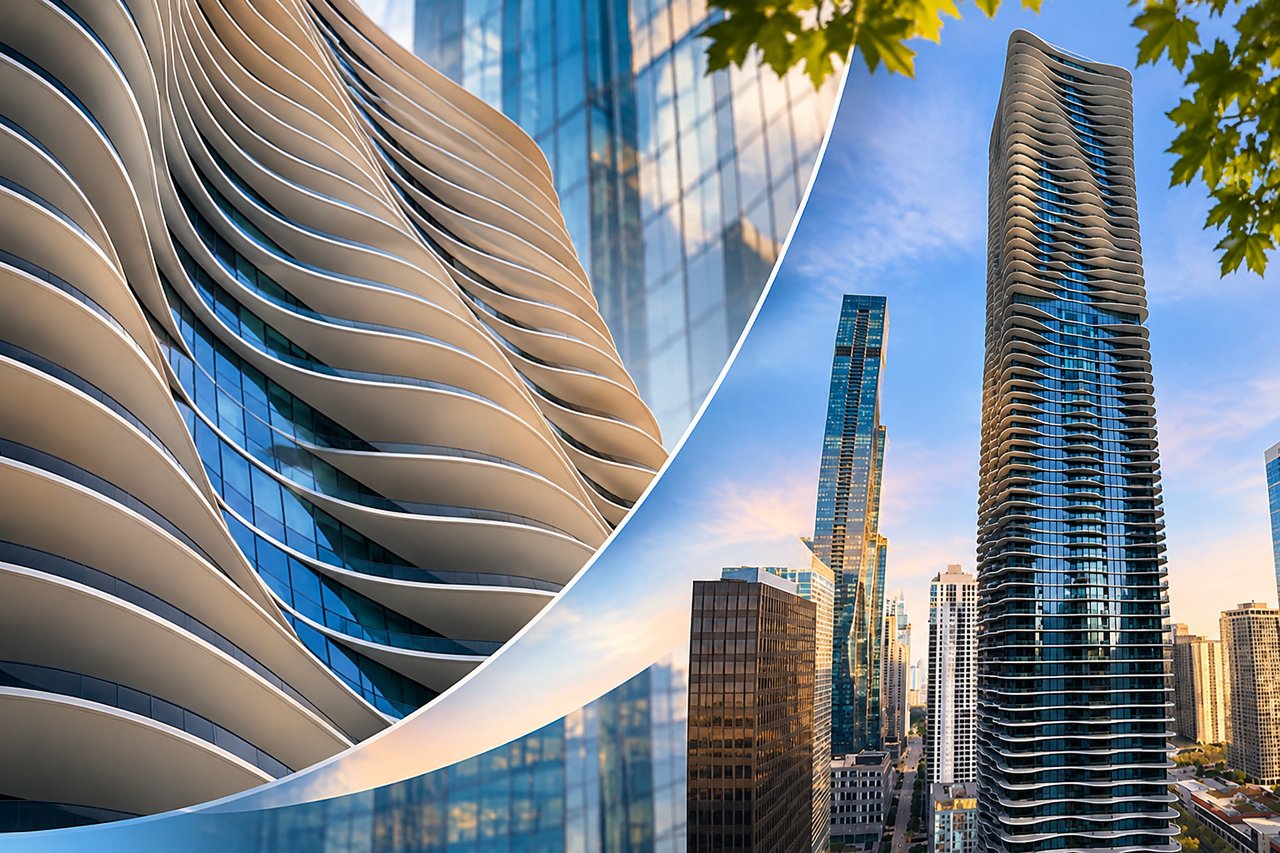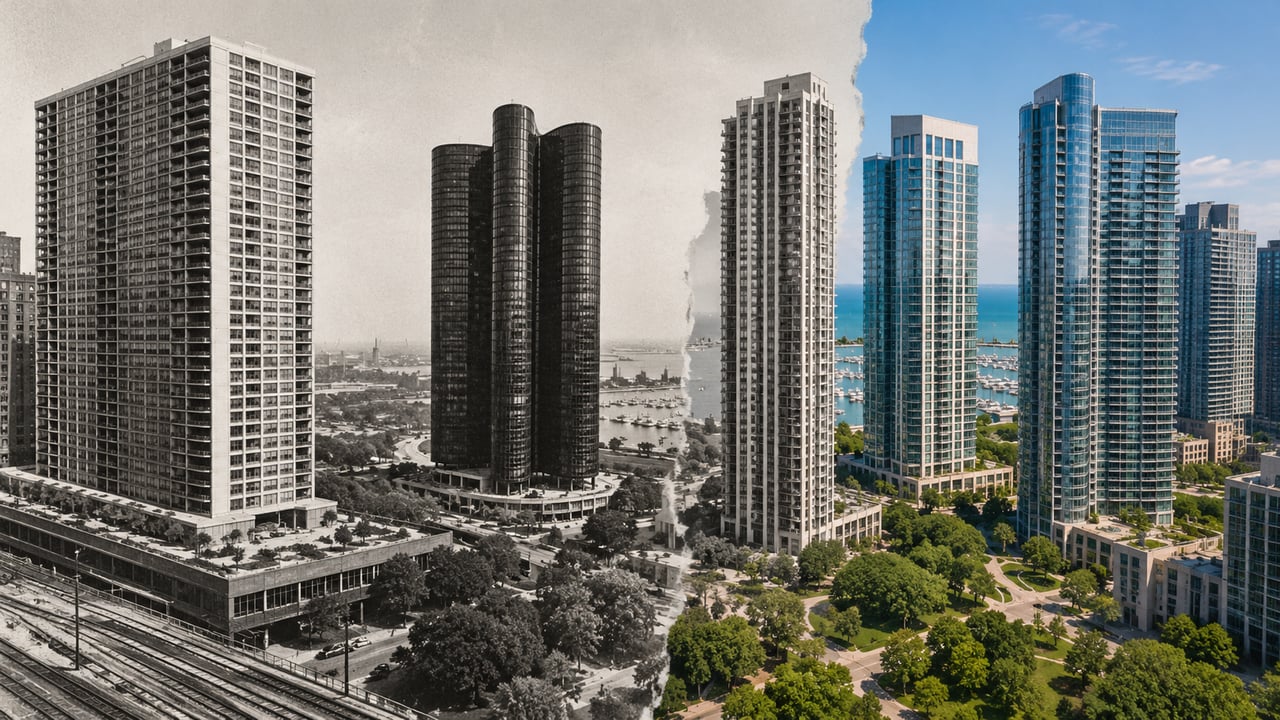
Long before Aqua and The Park at Lakeshore East, a generation of pioneering residential buildings was transforming Chicago's downtown lakefront.
Today, Chicago's New Eastside is known for its impressive skyline, landscaped parks, and proximity to Lake Michigan, the Chicago River, and Millennium Park.
But long before the modern Lakeshore East development took shape, a remarkable transformation was already underway.
Beginning in the 1960s, residential towers rose above former railroad land, introducing a new vision of downtown living. These buildings helped establish the neighborhood decades before Magellan Development Group introduced its ambitious Lakeshore East master plan.
Their story is an important, and sometimes overlooked, chapter in Chicago's architectural history.
400 East Randolph: A Pioneer in Downtown Living
The story begins with Outer Drive East at 400 E. Randolph Street, completed in 1963.
Designed by Hirschfeld, Pawlan & Reinheimer, the all-concrete tower was an extraordinary undertaking for its time.
Originally developed as a rental apartment building with more than 900 residences, it was constructed using air rights over the Illinois Central Railroad yards.
At its completion, Outer Drive East was one of the largest residential buildings in Chicago.
It also offered conveniences that were considered modern at the time, including central air conditioning.
The building was later converted to condominiums, becoming part of Chicago's emerging condominium market.
More than six decades later, 400 E. Randolph remains an important landmark in the New Eastside. Its continued evolution, including substantial renovations of common areas, shows how an established residential building can adapt to changing expectations.
Harbor Point: A New Landmark on the Lakefront
In 1975, Harbor Point at 155 N. Harbor Drive introduced a dramatically different architectural form.
Designed by Solomon Cordwell Buenz, the 54-story residential tower is distinguished by its curved, three-winged configuration.
Its unusual shape helped create a recognizable silhouette along Chicago's lakefront.
Harbor Point represented another step in the neighborhood's evolution. Downtown living was becoming increasingly attractive to people who wanted to be close to the business district without giving up access to the lakefront.
The tower remains one of the most visually distinctive buildings in the New Eastside. For more on the building today, see the Harbor Point building guide.
The 1980s: A Residential Neighborhood Takes Shape
By the 1980s, the area was no longer defined solely by isolated residential towers.
The Buckingham at 360 E. Randolph Street, completed in 1982, added another substantial residential building along the southern edge of what would eventually become The Park at Lakeshore East.
Its location offered access to downtown Chicago and the lakefront, reinforcing the neighborhood's residential character.
In 1988, North Harbor Tower at 175 N. Harbor Drive continued the expansion of high-rise living along the eastern side of the district.
Unlike the condominium buildings nearby, North Harbor Tower was developed as a rental apartment building, adding another housing option to the growing community.
The name New Eastside became increasingly associated with this developing residential district during the 1980s.
What had once been dominated by railroad infrastructure was gradually becoming a place where people could make their homes.
The Parkshore: Completing Another Chapter
The arrival of The Parkshore at 195 N. Harbor Drive in 1991 marked another important milestone.
The residential tower added to the concentration of high-rise buildings along Harbor Drive, strengthening the neighborhood's connection to Lake Michigan and the downtown waterfront.
By the early 1990s, the New Eastside had developed a recognizable residential skyline.
Yet something unusual remained at its center.
Despite the surrounding towers, a substantial portion of the land was still undeveloped.
And in 1994, that land would become something few people would expect to find among downtown skyscrapers: a nine-hole golf course designed by Pete Dye.
That unexpected chapter would eventually lead to an entirely new vision for the neighborhood.
Two Generations, One Neighborhood
Today, it is easy to associate Lakeshore East with contemporary buildings such as Aqua, The Lancaster, The Regatta, and The Chandler.
But the neighborhood's residential identity was established much earlier.
Outer Drive East, Harbor Point, The Buckingham, North Harbor Tower, and The Parkshore laid the foundation for what followed.
Each represents a different period in Chicago's architectural and residential development.
Their differences remain relevant today. Building design, floor plans, views, amenities, and the way residents experience the surrounding neighborhood vary considerably from one property to another.
For condominium buyers and owners, understanding these distinctions is an important part of evaluating a home.
The history of the New Eastside is not simply a story of old buildings giving way to new ones. It is a story of successive generations of architecture contributing to the same urban neighborhood.
And the next transformation would be the most ambitious yet.
Frequently Asked Questions About Chicago's New Eastside
What is the difference between New Eastside and Lakeshore East?
New Eastside generally refers to the broader downtown residential neighborhood that developed along East Randolph Street and North Harbor Drive beginning in the 1960s. Lakeshore East refers more specifically to the newer master-planned community developed around the central park beginning in the early 2000s. The names are often used interchangeably.
What was the first major residential high-rise in the New Eastside?
Outer Drive East at 400 E. Randolph Street, completed in 1963, was one of the neighborhood's earliest major residential developments. It helped establish high-rise living in this part of downtown Chicago.
Which residential buildings existed before the Lakeshore East development?
Several prominent buildings predate the modern Lakeshore East master plan, including Outer Drive East (400 E. Randolph), Harbor Point (155 N. Harbor Drive), The Buckingham (360 E. Randolph), North Harbor Tower (175 N. Harbor Drive), and The Parkshore (195 N. Harbor Drive).
Are older New Eastside condos different from newer Lakeshore East condos?
Yes. Buildings from different decades can vary significantly in floor plans, architectural design, amenities, monthly assessments, and building systems. Buyers should compare individual properties and association information rather than relying on building age alone.
The Lakeshore East History Series
- Part 1:From Railroad Yards to a New Urban Vision: The Story of Lakeshore East
- Part 2: Before Lakeshore East: The High-Rises That Built Chicago's New Eastside (you are here)
- Part 3:The Vision Behind Lakeshore East: A Neighborhood Built Around a Park
Own a condo in the New Eastside?Explore my Chicago condo selling strategy.
About Larissa Brodsky
Larissa Brodsky is a Chicago real estate broker affiliated with Compass and has been in Chicago real estate since 2008. She lives in Lakeshore East and specializes in downtown Chicago condominiums, including Lakeshore East, Streeterville, River North, and the Gold Coast. A Certified International Property Specialist with a Master's in Computer Science from DePaul, she follows the neighborhood's buildings as closely as its market.